
[ad_1]
Frieda Daniels is 89 years old. She is a wrestler, an acrobat and belongs to the Sinti community. She and her family were persecuted by the Nazis.
When Frieda first rope, in 1938, Hitler was already five years in power. At that time the Nazi state deported to Sinti concentration camps and Roma, who were unwilling to give up their profession. Some were merchants, musicians or artists. Since 1933 these professions were considered “unproductive or deceptive trades”.
In fact a sad topic: the Nazi persecution of her entire family and the lack of reparation. However Frieda Daniels, with her maiden name Lemoine, laughs a lot and out loud. Apparently she has done this very often in her life. Wrinkles of smile surround his eyes and mouth. She does not look like 89 years old, more like 60. The former wrestler still has a rope placed in the garden, on which he balances.
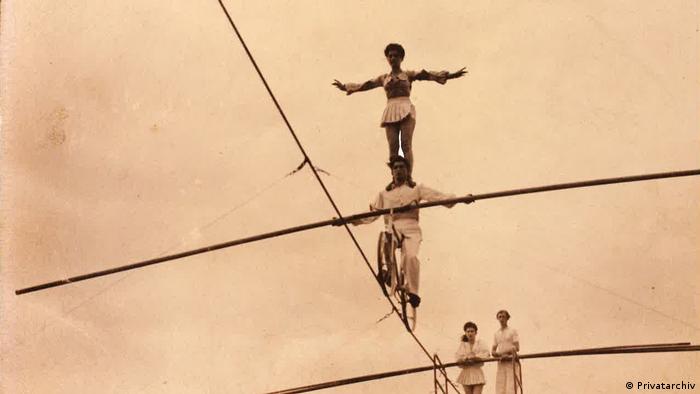
Frida first rode acrobatics when she was five years old. At the Stade, in Lower Saxony. “Everyone was holding their breath, watching and I jumped on the rope. All the people in the market came to the rope set up. In the end, everyone gave me some money, it was very nice! ” Frieda’s entire family were high rope dancers. Their permanent residence was Hamburg, but during the season they traveled around Germany on camping to display their art.
The ban on the profession hit Frieda’s family in 1942. They were prevented from leaving the place where they had been registered. For the Nazi regime this was preparation for deportation and extermination. Those affected had to stay in one place. Frieda’s family and many other Sinti and Roma were no longer able to practice their professions. They plunged into poverty.
“It was very bad, not easy at all,” says Frieda. She occasionally mixes German with English words. In 1954 he emigrated to the USA. Today she lives in Temecula, California. We talk on videocall.
They knew we were gypsies
“During the ban on leaving a certain territory, we suffered from hunger,” says Frieda. Sinti and Roma received far fewer food rations than others. Frieda and her siblings were no longer allowed to go to school. The other children cursed those “gypsies”. During the bombing no one allowed them in their shelters. “They knew we were gypsies because we had dark hair, dark eyes. My mother was pregnant, with ten children, the bombs were falling, the lanterns were burning and no one was letting us in. It was horrible.”
The Nazi regime wanted to register all Sinti and Roma in the police on the basis of biological racial affiliation. Even Frieda’s father, Johann. He had to undergo a “racial biological examination”: the Nazis measured and photographed Sinti and Roma in humiliating examinations – often by force – and prepared so-called “racial reports”. For the regime they considered “inferior race”.
Fear of deportation present everywhere
Once you were registered it was almost impossible to escape. Frieda’s father had to report to the Gestapo every two weeks while staying in one place and taking two children with him. Even Frieda had once been there. He was separated from his father and interrogated. Even today she has a feeling of insecurity, when she has to go to the authorities or when she looks at the police. For her mother, being questioned by the Nazis was the most horrible thing: “She was just crying. “She did not know if we would return.” The Nazis had meanwhile deported many of their relatives.
Frieda’s parents were constantly arguing over whether to stay or leave. Sooner or later there was a risk that they would be deported to a concentration camp, but they might still have a chance to be liberated earlier by the Allies. But if the Nazis caught them fleeing, they would be deported immediately.
Frieda gets up from the chair and takes a picture of her father to show me. Thin, proud, in a black suit, with black hair. He could have been a good diplomat, she says with a laugh. He has always had a lot of contacts, good connections. When they had no food, he found it. When they had no shelter, he found a new one. When they had to leave, he arranged train tickets.
Frieda and her family flee the Nazis
“My father was secretly listening to the BBC radio. “Thus he discovered that Hamburg would be bombed en masse.” They would have had no chance of surviving in their camp. In the middle of the night they took the train, leaving everything behind. They hid in Thuringia with their grandmother from a non-Sinti mother. In fact they wanted to return, but their camp was completely destroyed. Frieda says maybe that’s why they were lucky. Perhaps the Nazis had thought they had died in the bombing.
Frieda holds in front of the camera the post-1945 photo. She wants to tell me everything. The family lived in Kassel, but traveled all over Germany with her high-altitude performances. There are no previous photos, they were burned in the bombing. She asks her daughters and grandchildren to constantly bring her other photos.
I see Frieda in black and white photographs, at the age of 18 in front of her family’s camp, at the age of 20 on a high rope, or with her father auditioning at the Moulin Rouge in Hollywood.
Frieda continues to fight for compensation
Frieda to date has not received adequate compensation for the injustice she suffered. Only once around 2000 euros, that was all, she says. She is fighting for continuous compensation for the years when she was unable to go to school, for the economic damage caused by the loss of the profession, as well as for the mental and physical suffering. This is not the only case: the German government still does not recognize the so-called refusal to leave a certain territory as a measure of Nazi persecution.
Historians see this differently: The Nazi regime since 1939 pursued a policy of expelling from the German Reich all the remaining Sinti and Roma populations. Heinrich Himmler, commander of the SS forces, ordered a ban on leaving the territory to prepare for full deportation.
The report of the Independent Commission on Anti-Gynecology, published in 2021, calls for the few surviving victims to be finally adequately compensated. The German government charged the commission with examining for two years the situation of the Sinti and Roma communities. Frieda also continues to fight alongside the Central Council of Sinti and German Roma. In fact, it is not about much, about 400 euros per month.
“That would be a miracle!” But the Central Council says they are still in talks. But how long should this last? We are all almost 90 years old. We were there, we experienced it! ”/ DW
top channel
[ad_2]
Source link


