
[ad_1]
Crowded premises, indoor stays and urban movements without masks, the lack of social distancing, present for many months, create the idea that instead the pandemic is just a distant memory.
But Eurostat data and relevant national statistics show that Albania, along with two other countries in the region, Kosovo and northern Macedonia, are the three countries that have recorded the highest increase in additional mortality since March 2020, when the pandemic gradually “invaded” Europe by September 2021.
While 2020 ended with Albania marking the highest additional mortality in Europe (+ 26%), adding to the 9-month period 2021, our country has passed the third after Kosovo, which has had the strongest blow from the pandemic for loss of human lives, especially in the summer of 2021, and Northern Macedonia.
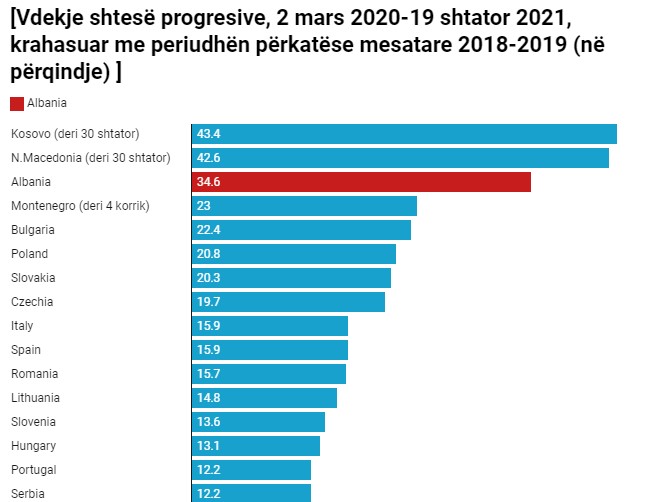
According to official data of KAS (Kosovo Agency of Statistics), in Kosovo, the additional cumulative mortality for the period March 2020-September 2021 compared to the corresponding average period 2018-2019 was + 43.4%.
In Kosovo, the situation worsened in the summer of 2021 after problems appeared with the supply of oxygen to hospitals and the start of delayed vaccination (see graph: Deaths by months, Kosovo).
For Northern Macedonia, the increase in fatalities for the same period is + 42.6%, according to data from the Statistical Office of the Republic of Macedonia, processed by Monitor.
Other Eurostat data on weekly deaths, where Albania also reports, show that for the period March 2, 2020-19 September 2021, additional fatalities increased by 34.6%, ranking our country third in Europe.
The start of vaccination in Albania in April 2021, a little earlier than in Kosovo and Northern Macedonia seems to have been the main factor that has curbed fatalities in Albania in relation to neighboring countries. But, already both of these states have higher rates or the same vaccination with us. According to Worldindata data, by December 26, 2021, Northern Macedonia had vaccinated 40% of the population. Kosovo, until January 9, 2022 had given doses to 50% of the population and Albania until January 9 had vaccinated 41% of the population. All three countries lag far behind the European Union average, which by early January had given at least one dose to 73% of the population and 70% had received both doses.
The data so far are showing that the poorer a country is the lower the attention to health and capacity to cope with pandemic crises. In fourth place is Montenegro, which until July 4, 2021 had an additional mortality increase of 24%. Serbia has coped better with the situation in the region, with additional fatalities rising by 12.2% by 19 September.
After Montenegro, it is Bulgaria that has had the most severe consequences of the pandemic, with an increase of 22.4% in additional mortality for the period in question, followed by Poland (20.8%), Slovakia (20.3%), the Czech Republic (19.7%) – (see graph: Additional progressive deaths, 2 March 2020-19 September 2021, compared to the corresponding average period 2018-2019).
The ranking continues with Italy, the country that faced the first pandemic wave in Europe and that by September 19, 2021 had marked a cumulative increase in additional deaths of almost 16%.
The Nordic countries have recorded fewer fatalities in Europe. Norway is the only country in Europe that has not seen an increase in additional mortality (-1.2%) since the onset of the pandemic. In Denmark, Iceland, Finland, growth was minimal between 1 and 3%. Germany, the country that has been strict with restrictive measures has seen an increase in additional fatalities since March 2020 by 4.2%. Sweden, the country that initially refused to take restrictive measures in order not to violate the freedom of its inhabitants has resulted in an additional death rate of almost 6%, higher than its neighbors, but lower than other European countries.
Eurostat data, which do not include Kosovo and Northern Macedonia show that Albania has taken the “lead” of additional mortality since the second week of November 2020, when the progressive growth was 25%, peaked in mid-March 2021 with +41 %, and dropped slightly to 35% by 19 September (see graph: Additional weekly progressive deaths, March 2, 2020-19 September 2021, compared to the corresponding average period 2018-2019).
The winter months are expected to have worsened the trend, while according to official statements there has been an increase in fatalities, starting in October.
Other national INSTAT data indicate that in the country. since April 2020, when the pandemic wave began to give the first consequences in Albania until the end of September 2021, there are about 11 thousand additional deaths in the country compared to the average of the respective periods 2016-2019./ Monitor
top channel
[ad_2]
Source link


