
[ad_1]
“Sky”, “Serenity” or “Audition” are the names of the large yachts that anchor each year on the Riva Sette Martiri, the main pilgrimage route for art in Venice, located between the meeting points of Arsenal and Serra dei Giardini.
But Russia’s art-loving oligarchs will not populate Lidon this time. They will not be the only Russians to be absent this year: Even Russia’s pavilion at the Biennale will remain empty. Kirill Savchenkov and Aleksandra Sukhareva, who were to perform there, have canceled their participation in Venice. Aleksandra Sukhareva, of Russian origin, wrote on Facebook: “There is no place for art when civilians are dying from rocket attacks, when Ukrainian citizens are hiding in bunkers, when Russian protesters are silent.” Lithuanian curator Raimundas Malasauskas said he could not continue with the project due to the Russian invasion of Ukraine. Like 27 other countries, Russia has its pavilion in Giardini, the main exhibition of the Biennale.
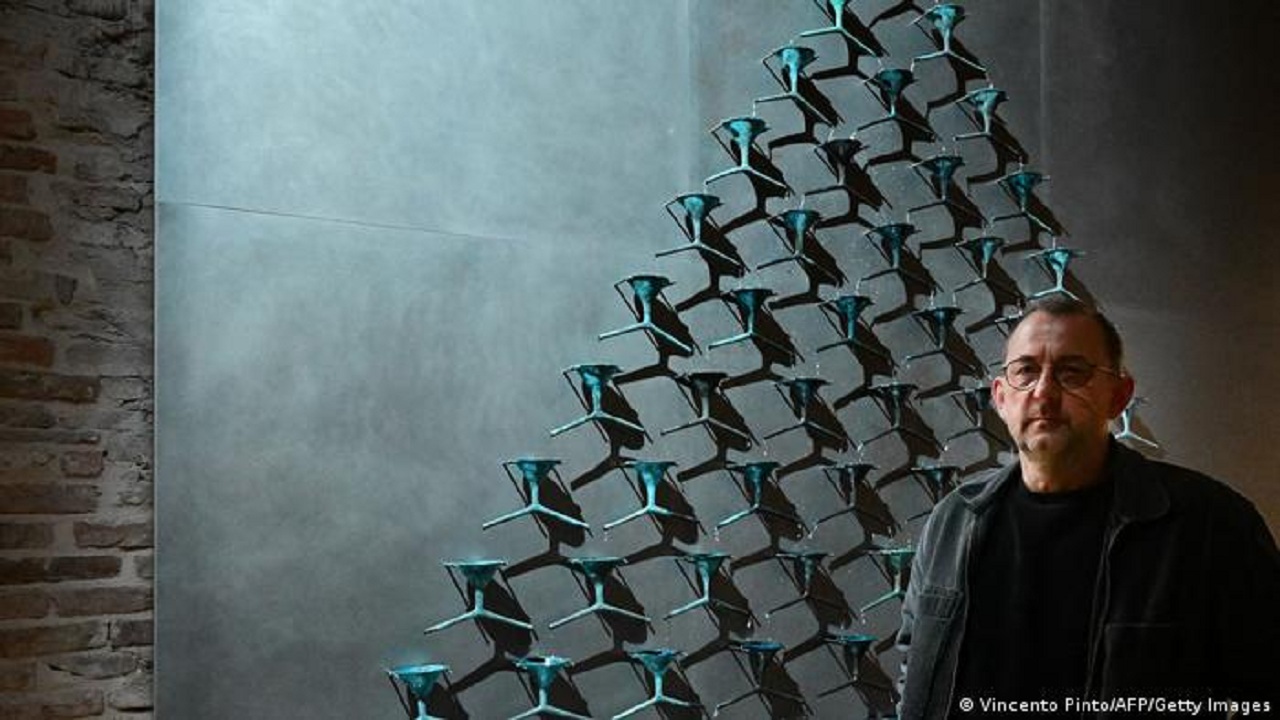
Pavlo Makov in the Ukrainian pavilion
For a long time it was uncertain whether the Ukrainian pavilion would open. But Kharkiv-born Ukrainian curator Kateryna Khueva and Ukrainian-born artist Pavlo Makov managed to transport the work from Ukraine to Venice. Makov managed to arrive in the lagoon town together with his 92-year-old mother. Khueva transported his installation from Kharkiv to Italy – a six-day journey through Romania. The team has been in Venice since April 16th.
Makov sees himself “not as an artist, but as a citizen,” he said in an interview with Swiss television. It does not represent a country at war, but symbolizes the vitality of Ukrainian culture. According to Makov, its installation is a sign of society’s exhaustion.
An Italian curator of the main exhibition at the Biennale
Another innovation: Cecilia Alemani is the first Italian curator to treat the main exhibition at the Art Biennale. The art expert, who lives in New York, had more time for the exhibition, which was postponed last year due to the corona virus. Why are there so few Ukrainians or Russians on her list of selected artists? It’s very simple: because it is impossible to take into account any nation, even in an exhibition as large as the Biennale, she says. Germany has selected only three historic Ukrainian positions and also contemporary Russian artist Zhenya Mahneva. “Fortunately,” says the German, “no one thought of expelling Mahneva because she is Russian!”
The 59th Art Biennial is dominated by women
Something rare is that the 59th Biennale, which opens this Saturday, April 23, coincides again with the documenta, held every five years in Kassel. In the lagoon town, the art lies in 79 country pavilions, in the central pavilion in Giardini and, of course, on the historic walls of the Arsenale, where once sailed the ships of the mighty Venetian fleet. The visual arts audience will see the power of female performance this year. For the first time in the Biennale’s 127-year history, most artists are women.
The motto of this year Biennale is “The Milk of Dreams”. The title is borrowed from a book about the fantastic beings of the English surrealist, Leonora Carrington (1917-2011). The painter, sculptor and writer emigrated from Europe to Mexico during World War II. Poetry, technology, ecology and feminism are, as Germany warned, the “main themes” of the central exhibition. In addition, the curator, who has a degree in philosophy, is displaying works by 213 artists from 58 countries. More than two-thirds of the artists are participating in Venice for the first time.
The name lists feature well-known artists such as Nan Goldin, Rosemarie Trockel and Barbara Kruger, as well as young sculptor and multimedia artist Monira Al Qadiri, a Senegalese-born Kuwaiti who was educated in Japan and now lives in Berlin. Sandra Mujinga also presents her work in Venice. The Congolese confronts the visitor with a very feminine, amorphous visual language, which fits well with the Biennale’s artistic environment. Only in September did she receive the Nationalgalerie Berlin award.
Golden Lion for German Katharina Fritsch
In the German pavilion, curated by the director of the Cologne museum, Yilmaz Dziewior, is invited to perform the concept artist from Berlin, Maria Eichhorn. Her art is considered somewhat serious, perhaps because of the laziness of the public to think. Because according to Eichhorn, born in 1962, a work consists of an idea, research and visualization: every work of art contains the requirement “Think once!”.
Its themes: the art market in the Nazi era and the expropriation of Jewish collectors. In general, the issue of ownership permeates as a red thread Eichhorn’s artistic work, as well as the concepts of work, value and time. Here, too, the Biennale could establish a link with the war in Ukraine, where Russian soldiers are stealing Ukraine’s cultural treasures. Of interest is expected to be the work of Eichhorn in the German Pavilion, a representative building of the Nazi era.
German artist Katharina Fritsch and Chilean artist Cecilia Vicuña are honored with the Golden Lion for their work of life. “Fritsch’s contribution to contemporary art, especially sculpture, is incomparable,” said the director of the German Biennale, who will present the award on the opening day. Among other things, Fritsch became known as “Rat King” (1993), a giant sculpture with sixteen black mice whose tails meet at a knot. The 59th Venice Art Biennale will be open from April 23 to November 27, 2022.
top channel
[ad_2]
Source link


