
[ad_1]
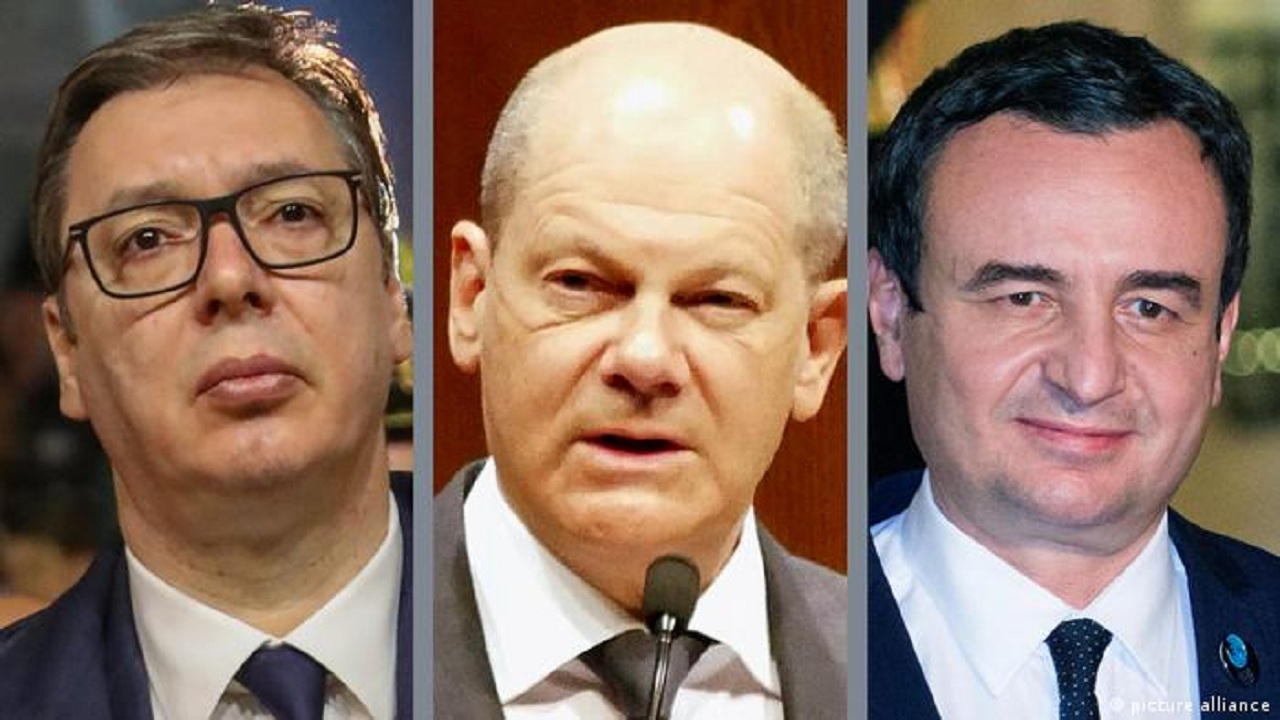
Chancellor Scholz receives Prime Minister Kurti and Serbian President Vucic. It is about sanctions against Russia, but also about Kosovo.
The President of Serbia, Aleksandar Vuçi., Is waiting for a long and unpleasant day in Berlin. There are many contentious issues on the agenda. The newly elected president actually wanted to keep a “word” in front of his people last week, but he has now postponed it to next Friday (05/06/2022).
The focus of the visit to Berlin is Serbia’s relationship with Russia and its pro-Russian stance. About two-thirds of Serbs see Russia as their most important ally. Right-wing parties hold regular rallies and loudly justify Russia’s war against Ukraine.
Serbia receives about 90 percent of its gas from Gazprom, currently at a “brotherly fee” of $ 270 per 1,000 cubic meters. In the market, gas costs three to four times more. But the new price is under consideration. Inflation in Serbia is more than 9 per cent, and a Russian gas embargo would nullify Vucic’s promise of prosperity in the country.
Chancellor Olaf Scholz should be aware of these developments. But since the Russian occupation of Ukraine, understanding of Serbian policy between East and West, Moscow and Brussels has waned in Berlin. Vucic’s formula – we condemn the violation of Ukraine’s territorial integrity, but reject any sanctions against Moscow – no longer seems stable.
The overture to a possible turnaround in Belgrade came last Thursday (April 28, 2022) through Serbian tabloids. On the front pages, newspapers close to Vuçi., Which in any case favored the policy towards Russia and Putin, harshly attacked Putin and the comparison of the Russian president between Donbas and Kosovo.
Olaf Scholz has invited the Prime Minister of Kosovo Albin Kurti for talks in Berlin, but he will keep the meetings separate. Afterwards, Kurti and Vucic will meet together with the EU Special Envoy for Kosovo, Miroslav Lajcak. None of them should be happy about this meeting. The dialogue on the so-called normalization of relations has been suspended for a long time. Belgrade does not recognize Kosovo’s independence and insists on forming an association of Serb-majority municipalities. While Kurti opposes this and reiterates that any conversation with Belgrade should lead to mutual recognition.
Now Scholzi apparently wants to show that the Kosovo problem will not be forgotten during the war in Ukraine. On the contrary: Berlin wants to fill the gaps in the Balkans, where Russian influence is evident. The Kosovo issue is likely to be the biggest challenge for the German government: Ultimately, Moscow is seen as a defense force in Belgrade – Russian veto power in the UN Security Council guarantees that Kosovo will be left out United Nations.
The German government also wants to show in other ways how important the Western Balkans is to its eyes. The Greens politician Manuel Sarrazin has been appointed special representative for the region, while in Bosnia the important post of high representative is held by former federal minister Christian Schmidt (CSU). Under the Dayton Accords (1995), the latter can enact or circumvent laws themselves.
This is what Schmidt is doing – especially given the efforts of Republika Srpska (Republika Srpska in Bosnia) to become increasingly independent. Milorad Dodik, the particularly pro-Putin leader of the Bosnian Serbs, regularly threatens secession.
Thus Dodik is becoming more and more a problem for Vucic, who for years has been presented in the West as a “stability factor” and allowed to secure his power at home with an iron fist. In Berlin, Vucic is expected to distance himself from Dodik, which should impress many voters in Republika Srpska.
Although he himself has aroused anti-Western resentment in Serbia for years, Vucic knows his country is in urgent need of rapprochement with the EU. His economic policy is also oriented towards Brussels. About two-thirds of Serbian exports go to the EU, while Russia is a marginal market with about four percent. German companies alone employ about 70,000 people in Serbia, drawn from freelance work and large state subsidies.
In a recent Bundestag resolution calling for arms shipments to Ukraine, the federal government called for EU pre-accession assistance for those candidates who “evade” Western sanctions to be “reviewed”. This also means Serbia.
Vucic has repeatedly stressed that Western pressure on Serbia has increased. It is not yet known what sanctions Belgrade may pursue.
EU membership
Like all Western Balkan countries, Serbia is officially on its way to the EU. But Balkan experts have described it this way for years: The EU is pretending to want to join Southeast Europe, while Serbia is pretending to reform itself.
With the war in Ukraine, there is a glimmer of hope that things can go faster. Scholz has repeatedly stressed that the EU must keep its integration promises to the Balkan states. But with Emmanuel Macron, it will be difficult because he has often stalled EU enlargement. The addition of new seats is also not particularly popular among Western European voters.
This is why Vucic critics at home fear that the Serbian ruler may continue to run his de facto one-party state autocratically without strong criticism from the West. So it was in Angela Merkel’s time: Stability in the Balkans has always been before conforming to democratic standards.
top channel
[ad_2]
Source link


